Quick Answer for B2B Healthcare Outreach
A Canadian medical directory works best as the starting point for outreach planning, not a one time contact pull. Sales, marketing, and recruitment teams get the most value when they segment the directory by specialty, province, and practice type, then export the matching records into their CRM or campaign tools.
The main takeaway: Scott’s MD Select turns a Canadian medical directory into a usable B2B outreach asset by letting a team define the professional segment it needs, such as specialty, province, or career stage, filter the directory by those same criteria, and then export the matching records into the sales or marketing workflow already in place.
Scott’s MD Select maintains this kind of data for the healthcare professionals it covers, from physicians and surgeons to nurse practitioners, dentists, and pharmacists, with a searchable database and downloadable records supporting that process.
Reaching a physician, a nurse practitioner, or a dentist for a legitimate business purpose is a different exercise than finding a consumer lead. Healthcare professionals move between practices, take on hospital or university appointments, and split their time across specialties, so a static list becomes outdated quickly. A medical directory built for B2B use accounts for that movement and gives outreach teams a way to filter for exactly the audience a campaign, sales territory, or recruitment search requires.
This page covers what a directory profile typically includes and why data accuracy shapes healthcare campaign results. It also looks at how sales, marketing, recruitment, and pharmaceutical teams each use this data differently. The final section shows how a completed search moves into a CRM or mailing tool, ready for outreach.
Curious how the search and filtering tools work? Start a free trial and try them firsthand.
What a Canadian Medical Directory Includes for B2B Users
A directory built for B2B use goes well beyond a name and a phone number. Scott’s MD Select structures each profile with the fields a sales, marketing, or recruitment team actually needs to qualify and reach a contact, rather than a single flat address list.
Profiles in the Scott’s MD Select database typically include:
- Name, mailing address, and practice location
- Telephone and fax numbers
- Graduating university and year of graduation
- Degrees and fellowships
- Medical specialties and subspecialties
- Medical interests
- Industrial, hospital, or university appointment details
- Number of prescriptions written per day
- Languages spoken
- User added notes for tracking outreach history
That depth is what separates a medical directory from a general business contact list. A generic list might confirm that a clinic exists at a given address. A directory built around healthcare professionals confirms who practices there, what they specialize in, where they trained, and how a business can reasonably expect to reach them. For a B2B team planning a campaign toward physicians, specialists, or allied health professionals, those extra fields are what make a list usable instead of just present.
The directory also spans more than one professional type. Beyond physicians and surgeons, Scott’s MD Select maintains dedicated directories for nurse practitioners, dentists, and pharmacists, along with a broader medical experts directory and a list of hospitals across Canada. A team that needs a single specialty can search narrowly, while a team planning a wider campaign can pull across professional categories from the same underlying data.
See the full range of profile fields available in the medical experts directory before scoping your next outreach list.
Why Verified Physician Data Matters for Healthcare Campaigns
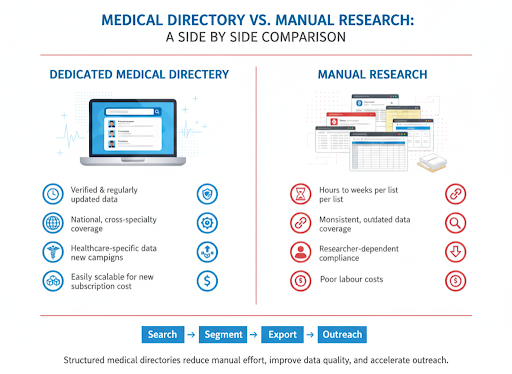
Outdated contact information is one of the most common reasons a healthcare outreach campaign underperforms. Physicians and specialists open new practices, join group clinics, or relocate every year, and a directory that was accurate twelve months ago can already be missing new practitioners or pointing to a closed office.
This is where a purpose built medical database earns its place over a scraped or purchased generic list. Scott’s MD Select tracks the thousands of general practitioners and specialists who either start a practice or change locations each year, which keeps the directory closer to the current state of the profession than a static file that never gets revisited. For a campaign built around timing, such as a product launch or a territory realignment, working from a directory that reflects recent moves reduces the number of contacts that bounce or go to a professional who has already relocated.
Verified data also protects the credibility of the outreach itself. A sales or marketing message that reaches a physician at the wrong address, under the wrong specialty, or addressed to a role they no longer hold reflects poorly on the sender before the message is even read. Working from a segmented directory that filters by specialty and location reduces that risk by aligning the message with a contact who is still practicing in the way the campaign assumes.
For pharmaceutical, medical device, and healthcare marketing teams specifically, this accuracy compounds. A campaign built around specialty targeting only works if the specialty field is current, and a territory plan only holds up if the location field reflects where a physician practices today rather than where they trained years earlier. Reliable data is what allows those downstream decisions, segmentation, messaging, and territory design, to hold together as a coherent process rather than a series of assumptions.
Review how physician profile data is structured in the physicians and surgeons directory to see the fields available for your campaign.
How MD Select Maintains Accurate Records
Scott’s MD Select regularly updates its medical database to reflect changes in physician practice locations, specialties, and professional contact information such as email addresses and phone numbers. That update cycle is what allows the directory to stay useful for outreach rather than becoming a historical record of where physicians used to practice.
The company behind Scott’s MD Select, Scott’s Directories, has compiled Canadian business and professional data for more than 60 years, a history that predates most digital contact databases entirely. That longevity matters less as a marketing point and more as an operational one: maintaining a directory of this size requires a continuous process for tracking practice changes, new graduates entering the profession, and specialists moving between hospitals or clinics, rather than a one time data pull.
Search and filtering are also part of how the directory stays usable at scale. Scott’s MD Select allows users to search and filter medical data by specialty, subspecialty, province, city, practice location, and other criteria, which means a team is not working from one static export but from a live, queryable dataset. When a search is rerun closer to a campaign launch, it reflects the current state of the directory rather than a snapshot taken months earlier.
Data handling also follows Canadian data protection and privacy expectations. Scott’s MD Select provides professional medical data in a responsible and compliant manner, with contact details intended for legitimate B2B and healthcare related use rather than for consumer outreach. That framing matters for any team building a compliance review around a new outreach channel, since it clarifies both the intended use of the data and the boundaries around it.
See the history behind the data and the company that maintains it on the Scott’s MD Select about us page.
Segmenting Contacts by Specialty, Province, and Practice Type
Segmentation is what turns a medical directory in Canada wide in scope into a workable, regional outreach list. Scott’s MD Select organizes its Canadian physician data across three main dimensions, specialty, province, and practice type, so a team can narrow more than 91,000 professional records down to the exact audience a campaign or sales territory requires.
By specialty:The directory covers more than 60 medical specialties and subspecialties, ranging from high volume categories such as Family Medicine and General Practice down to smaller, more specific fields such as Vascular Surgery or Anatomical Pathology. A team introducing a specialty specific product or service can filter directly to the physicians who practice in that field rather than sorting through a general list afterward.
By province: Provincial directories are available for Ontario, Alberta, British Columbia, New Brunswick, Manitoba, Nova Scotia, Quebec, and Saskatchewan. This matters for any team that plans outreach around a defined sales region or a province specific regulatory or market consideration, since it allows a search to start at the provincial level before narrowing further by specialty or city.
By practice type: Beyond physicians and surgeons, the directory distinguishes between recent medical school graduates, established specialists, general practitioners, and nurse practitioners, along with hospital and university appointment details. A recruitment search or a campaign aimed specifically at newer practitioners can filter on that basis rather than treating every contact the same way.
| Segmentation Dimension | What It Narrows | Typical Use Case |
| Specialty and subspecialty | 60+ medical specialties, from Family Medicine to Vascular Surgery | Targeting a product or service relevant to one clinical field |
| Province and city | Ontario, Alberta, BC, New Brunswick, Manitoba, Nova Scotia, Quebec, Saskatchewan | Planning a regional sales territory or provincial campaign |
| Practice type | Physicians, specialists, recent graduates, nurse practitioners | Recruitment searches or campaigns aimed at a specific professional stage |
These dimensions are not mutually exclusive. A search can combine all three at once, for example, filtering for cardiologists in Ontario who graduated within the past several years, which is where a broad database becomes a precise outreach list.
Browse a provincial example in the Ontario medical directory to see specialty and practice type filters in action.
How Sales Teams Use Directory Data to Plan Territories
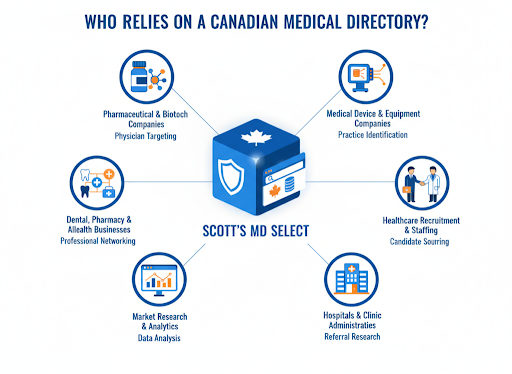
Territory planning depends on knowing not just how many physicians practice in a region, but which specialties are represented and how that population shifts over time. Sales teams across Canada use Scott’s MD Select to reach physicians and specialists with accurate data, building that picture before a territory is finalized rather than after.
Who Relies on Territory Level Directory Data
- Medical equipment and supply distributors
- Medical testing and diagnostics manufacturers
- Healthcare consulting firms
Spotting Territory Opportunities Early
Because the directory tracks the thousands of general practitioners and specialists who start a practice or change locations each year, a sales team can identify high potential prospects as they enter a market rather than relying on a contact list that only reflects established practices. A static list would typically miss situations such as:
- A newly opened clinic inside the assigned territory
- A specialist who has recently relocated into the region
Multiple search and filter combinations support this kind of territory work, letting a team slice the data across specialty, location, and practice detail fields to build a list scoped to exactly the region a territory covers, rather than working from a broader export and manually removing contacts that fall outside it.
Prioritizing Outreach Within a Territory
This segmentation also supports how a sales team prioritizes its own time. A territory built around verified specialty and location data allows a rep to sequence outreach toward the highest relevance prospects first, rather than working through a list in whatever order it was originally compiled. That kind of prioritization is what makes a large geographic territory manageable, whatever the size of the sales organization running it.
See how territory level segmentation works for sales and marketing teams using Scott’s MD Select.

How Marketers Use Segmented Data for Targeted Campaigns
Marketing campaigns aimed at healthcare professionals depend on reaching a narrow, relevant audience rather than a broad one. A medical directory Canada wide in scope rarely serves that purpose well without segmentation, since it mixes specialties, provinces, and practice types that have little in common. Scott’s MD Select addresses this by letting marketers filter the directory down to the specific segment a campaign targets before any outreach begins.
A campaign built around a new product for a particular specialty, for example, can pull a list limited to that specialty and the provinces where the campaign is running, rather than a wider physician list that includes contacts with no relevance to the offer.
One Export, Multiple Outreach Channels
Because records include mailing addresses and phone numbers alongside specialty and location fields, a single downloadable, CSV formatted export can feed more than one channel at once, without the marketing team rebuilding the contact data separately for each one:
- A direct mail campaign
- A targeted email sequence
- A call list
Connecting Inbound and Outbound Marketing
Marketers working in healthcare also benefit from the directory’s connection to inbound efforts. Scott’s MD Select pairs its outbound data with search engine optimization and search engine marketing services, so a team running paid or organic campaigns toward the same healthcare audience can align its inbound and outbound targeting around the same specialty and regional segments rather than treating the two as separate efforts.
Explore how segmented lead data supports targeted lead generation campaigns for healthcare marketers.

How Recruiters Identify and Reach the Right Professionals
Recruitment in healthcare carries its own version of the segmentation problem. A staffing firm or a healthcare employer is not just looking for any physician or nurse practitioner, but for one with a specific specialty, in a specific region, and often at a specific stage of their career.
Career Stages Recruiters Search For
- A recent graduate entering the workforce
- An established specialist open to a new opportunity
Scott’s MD Select supports this kind of search through its dedicated nurse practitioner database, which allows recruiters to filter by province, specialization, and practice or clinic affiliation, rather than starting from a general database and manually identifying which contacts are nurse practitioners.
For a closer look at how this data speeds up hiring, see 6 Ways a Nurse Practitioner Database Aids Recruitment, which breaks down filtering by province, specialization, and clinic affiliation in more detail.
Recruitment Specific Search Filters
The directory’s inclusion of recent medical school graduates adds another layer to recruitment specific searches, giving a recruiter a clearer picture of a candidate’s current professional setting before any outreach is made:
- Graduation year, for building a pipeline of newly qualified professionals
- Specialty and location
- Hospital or university appointment details
Moving a Shortlist Into Your Hiring Workflow
Because records in the directory are downloadable, a recruiter can move a shortlist directly into whatever applicant tracking or CRM system their firm already uses, rather than manually transcribing contact details from a search results page. That difference can affect how quickly a search moves from shortlist to outreach against a hiring timeline.
Search the dedicated nurse practitioner database to filter candidates by province and specialization.
Supporting Pharmaceutical and Medical Device Outreach
Pharmaceutical and medical device companies use this kind of directory differently than a sales team building a general territory, but the underlying need for accurate, specialty segmented data is the same.
Identifying High Prescribers
A pharmaceutical company introducing a product relevant to a particular condition or specialty can use the directory’s specialty and subspecialty fields, along with prescription volume data, to prioritize outreach toward physicians whose practice profile aligns with the product.
Supporting Clinical Research and Expert Recruitment
Companies use the directory to identify physicians for clinical research, studies, and expert opinion work, drawing on specialty and credential fields such as degrees, fellowships, and hospital or university appointments. A researcher looking for a specific subspecialty and an academic appointment can filter for both at once.
Tracking Market Mobility for Early Outreach
Because the directory stays current with the general practitioners and specialists who start a practice or change locations each year, pharmaceutical and medical device teams can identify newly established practices as potential targets for early outreach.
Filtering Criteria That Support Compliant Outreach
Across all three use cases above, a team can build a list scoped tightly enough for a compliant, relevant outreach program by filtering on:
- Specialty and practice status
- Professional credentials, such as degrees and fellowships
- Provincial jurisdiction
Learn more about how the directory supports pharmaceutical companies identifying specialists and high prescribers.
Exporting Records for CRM and Campaign Tools
A segmented list only creates value once it moves into the system a team actually works from, whether that is a CRM, an email platform, or a direct mail process.
Where Exported Records Load Directly
Records download in CSV format, a structure that loads directly into most of the following without additional formatting work:
- CRM platforms
- Spreadsheet tools
- Mail merge systems
Subscription Tiers by Download Volume
- A search and print only tier, for teams that do not need to download records
- Tiers built for tens of thousands of downloads, suited to a single provincial campaign
- Unlimited downloads, suited to larger or ongoing national campaigns
Tools That Support Ongoing Campaign Management
- User added notes to track outreach history directly against a contact record
- Unlimited label printing to support direct mail campaigns run alongside digital outreach
For a team running multiple campaigns against overlapping segments of the directory, this kind of built in tracking reduces the risk of duplicate or conflicting outreach to the same contact.
Compare download volumes across the medical mailing list subscription options before scoping a campaign.
Building a Repeatable Outreach Process With Reliable Data
A single successful campaign is useful, but a repeatable process is what actually compounds over time for a B2B healthcare team. Building that repeatability starts with treating the directory as an ongoing resource rather than a one time list purchase.
Standardizing How Segments Are Defined
A team that documents its specialty, province, and practice type filters for a given campaign can rerun that same search months later with updated results, rather than rebuilding the logic from scratch each time. Because Scott’s MD Select maintains the directory as a live, searchable dataset, a saved search reflects new practices and relocations automatically the next time it runs.
Staying Consistent Across Professional Categories
A team running campaigns across more than one healthcare audience, for example both physicians and dentists, benefits from having both segments available in the same underlying platform. The dentist directory available through Scott’s MD Select is one example, offering the same kind of specialty and location filtering used elsewhere in the platform, scoped to dental professionals.
If you are weighing whether that added depth is worth it, Dentist Directory vs General Contact List for Outreach compares a specialty directory against a generic list field by field.
Closing the Loop Between Data and Results
Because records can carry user added notes and download history, a team can track which segments produced the strongest response and adjust future searches accordingly, rather than starting each new campaign with the same broad assumptions as the last.
See how research and data teams structure repeatable searches using Scott’s MD Select for data and research.
Planning Healthcare Outreach With MD Select
A Canadian medical directory is only as useful as the process built around it. That process comes down to three moves: define the professional segment, filter by specialty, province, and practice type, then export the result into a CRM or campaign tool. The same process works whether the goal is a sales territory, a marketing campaign, a recruitment search, or a pharmaceutical outreach program.
What separates a productive outreach program from a frustrating one is usually not the size of the list but its relevance and its accuracy at the moment outreach begins. Scott’s MD Select maintains its Canadian physician, nurse practitioner, dentist, and pharmacist data with that goal in mind, structured for search, segmentation, and export rather than for browsing alone.
Planning a new outreach program, or reviewing whether an existing contact list still reflects where healthcare professionals currently practice, is a reasonable point to bring in a data resource built specifically for this purpose rather than adapting a general business contact list to a healthcare use case it was never designed for.
Ready to scope your next outreach list? Contact Scott’s MD Select to discuss which segments of the Canadian medical directory fit your campaign.