Importance of a Canadian Medical Directory
Understanding what a Canadian medical directory offers has become increasingly important in today’s B2B marketing scene. This guide explains how medical directories differ from medical databases, what information they contain, and how organizations use verified physician data to support sales, marketing, recruitment, research, and business development.
It also covers the characteristics of a reliable Canadian medical directory, practical evaluation criteria, methods for building targeted prospect lists, and strategies for selecting a provider that aligns with organizational requirements. Throughout the guide, readers will find comparison tables, checklists, and actionable insights designed to support informed purchasing decisions.
The key takeaway: A Canadian medical directory is more than a searchable list of healthcare professionals. When supported by accurate, structured, and regularly maintained data, it becomes a valuable business resource for identifying healthcare professionals, improving audience segmentation, and supporting more effective outreach across Canada’s healthcare sector.
Organizations involved in healthcare sales, marketing, recruitment, or business development depend on accurate physician data to identify the right contacts. Success often depends on identifying the right healthcare professionals who align with the organization’s products or services.
That’s the job of a Canadian medical directory, a structured, searchable source of verified contact and professional information on doctors, specialists, and other healthcare providers across the country. For sales, marketing, recruitment, and business development teams, a reliable medical directory that Canadian professionals can trust is essential. It’s the foundation on which everything else gets built: territory plans, outreach campaigns, CRM pipelines, and recruitment shortlists alike.
This guide breaks down what a medical directory is, how it differs from a raw medical database, what separates a trustworthy provider from a stale one, and how to put the data to work, with practical checklists, comparisons, and answers to the questions teams ask most often before they buy.
What Is a Canadian Medical Directory?
A Canadian medical directory is a structured listing of healthcare professionals, typically physicians, specialists, nurse practitioners, dentists, and pharmacists, that includes verified contact details, practice information, and professional credentials. Unlike a general business directory, a medical directory is built specifically around the structure of the healthcare system: provincial licensing, hospital affiliations, specialty designations, and practice settings that don’t map cleanly onto standard B2B data.
The term gets used somewhat interchangeably with “medical database,” but there’s a useful distinction for buyers evaluating their options.
What’s Typically Inside a Medical Directory Record
A well-built medical directory record usually includes:
- Full name, designation, and licensing status
- Specialty and sub-specialty
- Practice address(es) and phone number
- Email (where available and compliant to share)
- Hospital or clinic affiliations
- Graduation year and medical school
- Province/territory of practice
- Language(s) spoken
These fields allow organizations to filter, segment, and prioritize healthcare professionals based on specific outreach objectives.
Why Accurate Physician Data Matters More Than Ever
Canada’s healthcare system operates across multiple provinces and territories, each with its own licensing bodies, healthcare organizations, and practice environments. Physicians may change practice locations, join new hospitals or clinics, expand into different specialties, or update professional affiliations over time. These changes can quickly affect the accuracy of outreach lists.
For organizations involved in healthcare sales, marketing, recruitment, and business development, reliable physician data supports more informed decision-making. Accurate records help teams identify the right healthcare professionals, build relevant prospect lists, and organize campaigns based on specialty, location, practice type, and other important criteria.
Working with up-to-date, well-maintained physician information also reduces the time spent manually verifying contacts. Instead of relying on scattered public sources or outdated records, organizations can focus on planning targeted outreach, improving segmentation, and supporting more efficient sales and marketing workflows.
The Real Cost of Outdated or Incomplete Data
Physicians relocate. They change hospital affiliations. They retire, merge practices, or shift from general practice into a sub-specialty. A directory that isn’t refreshed regularly accumulates “data rot” quickly, and the downstream costs show up in predictable ways:
- Wasted outreach budget on contacts who’ve moved, retired, or changed roles
- Compliance risk from contacting professionals using outdated consent or licensing status
- Lost time for reps manually re-verifying details that should already be accurate
- Damaged credibility when a pitch references an affiliation or location that’s no longer correct
This is precisely the problem that a properly maintained Canadian doctors directory is designed to address. For this reason, data freshness should be one of the first evaluation criteria when comparing providers.
Who Relies on a Canadian Medical Directory?
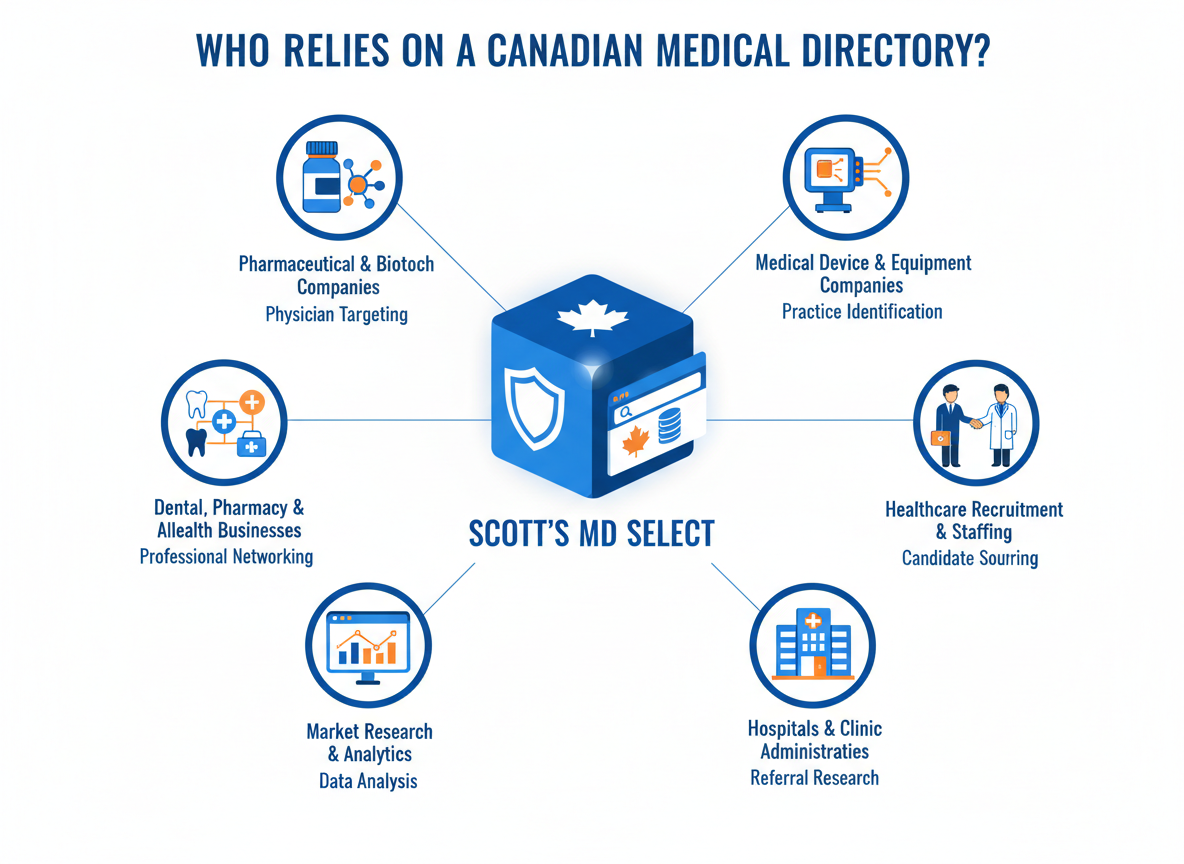
A reliable medical directory supports more than sales activities. Across the healthcare ecosystem, it supports:
- Pharmaceutical and biotech companies targeting physicians by specialty for product launches
- Medical device and equipment distributors identifying practices and hospitals that match their offering
- Healthcare recruitment and staffing firms sourcing and verifying candidate credentials
- Hospital and clinic administrators researching peer institutions or referral networks
- Market research and analytics teams building specialty- or region-based market assessments
- Dental, pharmacy, and allied health businesses running parallel outreach to adjacent professions
Although the use cases differ, each depends on accurate, searchable healthcare data to support informed business decisions.
Key Features of a High-Quality Canadian Medical Directory Online
Not all directories are built the same way, and the gap between a strong one and a weak one usually isn’t obvious until a few months into a campaign that isn’t converting. Here’s a practical checklist for evaluating any medical database or directory before selecting a provider.
Coverage & Scale
- Does it cover all provinces and territories, not just major urban centres?
- Does it include both general practitioners and specialists?
- Are adjacent professions (nurse practitioners, pharmacists, dentists) available if needed?
Verification & Update Frequency
- How often is the data refreshed, and how is it sourced?
- Is there a visible methodology for verifying license status and affiliations?
Search & Filtering Depth
- Is it possible to filter by specialty, sub-specialty, location, hospital affiliation, and language?
- Are there enough filter combinations to build genuinely targeted lists (not just province-level searches)?
Access & Export Options
- Is it possible to search online and export to CRM, or is it limited to one or the other?
- Does it support saved searches and reusable segments?
Support & Service
- Is there responsive customer support if a team needs help structuring a search or troubleshooting an export?
- Are onboarding and training available for new team members?
A directory that meets these evaluation criteria supports more efficient healthcare outreach by improving search, segmentation, and campaign planning.
How to Build a B2B Prospect List Using a Medical Directory
Once a directory has been selected, the next challenge is using it effectively. Building a strong medical B2B prospect list depends on thoughtful segmentation rather than exporting the largest possible list.
Define the Ideal Customer Profile First
Before searching, define the target audience by specialty, practice setting, geography, and purchasing role. Skipping this step is the single most common reason prospect lists underperform: teams end up with volume rather than relevance.
Segment by Specialty, Geography, and Practice Type
A flat list of “Canadian doctors” is rarely useful on its own. Segmenting by specialty, province, city, hospital affiliation, or practice type supports more relevant messaging rather than sending a single generic pitch to a list that includes wildly different buyer contexts.
Validate Before Launching Outreach
Cross-check key details, especially affiliation and location, against the most recent directory update before launching outreach, particularly for high-value or long sales-cycle targets.
How to Search Smarter and Get More from the Medical Directory
Some organizations use a medical directory primarily for basic searches, which can limit the value available from advanced filtering and segmentation capabilities.
Combine Filters Strategically
Rather than searching by province alone, layering multiple filters together helps narrow results more effectively. Each additional filter narrows the list to genuinely qualified prospects and reduces wasted contacts.
Save and Reuse Segmented Lists
Building reusable saved searches for general practitioners in one segment and specialists in another keeps campaigns consistent and saves significant time on repeat outreach cycles.
Turn Search Results into Actionable Insights
Mapping where specialty clusters concentrate geographically, or tracking which segments respond best to outreach, turns a directory from a lookup tool into an actual planning input for territory and campaign strategy.
These advanced search techniques for smarter searches and greater benefit from medical directories are beneficial for organizations looking to improve search efficiency and segmentation.
Medical Directory vs. Manual Research: A Side-by-Side Comparison
Some teams attempt to build their own contact lists manually, combining LinkedIn searches, provincial college registries, hospital websites, and old contact lists. Comparing both approaches highlights the operational differences.
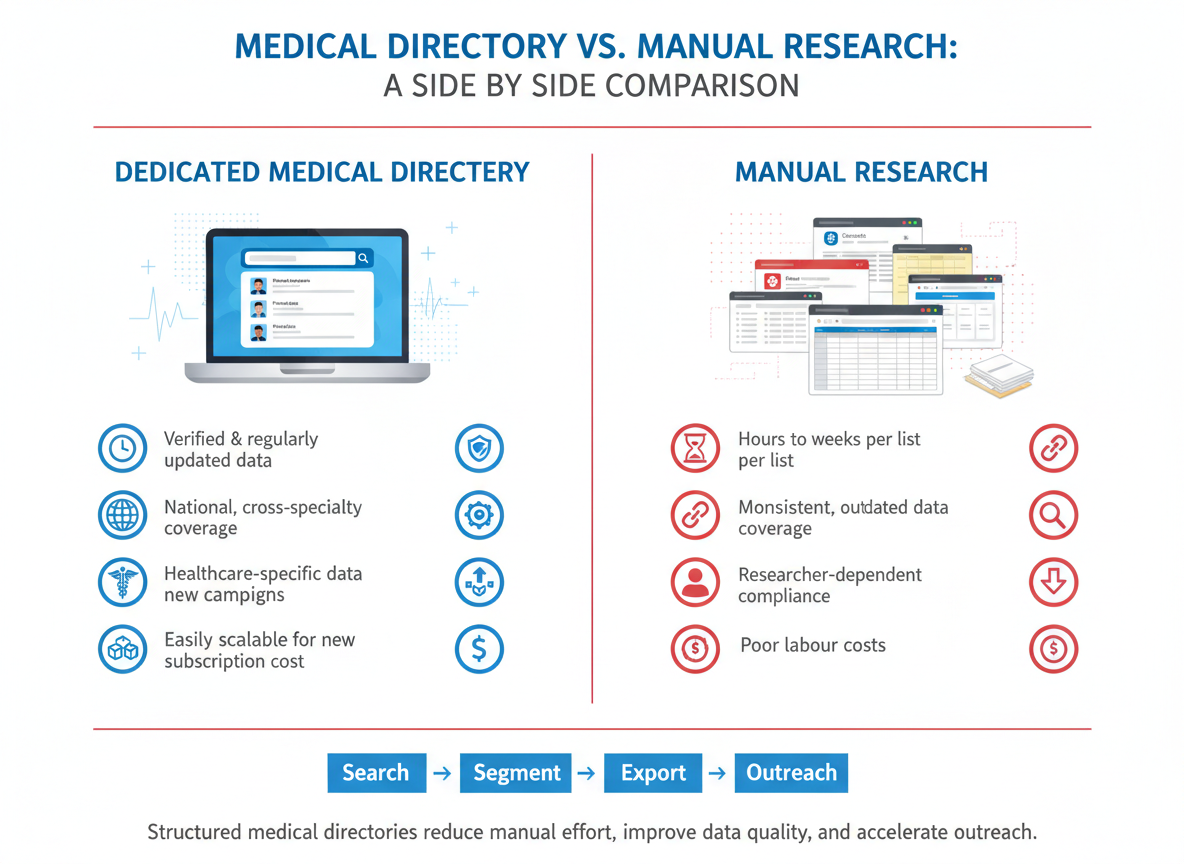
| Factor | Dedicated Medical Directory | Manual Research |
|---|---|---|
| Time investment | Minutes per search | Hours to weeks per list |
| Data accuracy | Verified and regularly updated | Inconsistent; often outdated quickly |
| Coverage | National, cross-specialty | Limited to what’s manually found |
| Compliance support | Built around healthcare-specific data practices | Depends entirely on the researcher |
| Scalability | Easily repeated for new campaigns | Doesn’t scale without major added effort |
| Cost | Predictable subscription cost | “Free,” but high hidden labour cost |
Manual research may support occasional projects, but organizations conducting ongoing healthcare outreach often benefit from a structured medical directory that simplifies segmentation, improves data consistency, and reduces manual effort.
Choosing the Right Canadian Medical Directory Provider
With the case for using a directory established, the harder question is which provider best aligns with organizational requirements. Use this checklist when comparing options:
- Does the provider disclose how data is sourced and verified?
- Is coverage truly national, including smaller provinces and rural regions?
- Are both online search and downloadable/exportable access available?
- Is pricing transparent and flexible for different team sizes?
- Does the provider have a track record, ideally years, not months, serving the Canadian healthcare data market?
- Is responsive support available if the team needs help with searches or exports?
Selecting a healthcare database involves more than comparing subscription costs. It is hence essential to evaluate the factors that influence long-term value, including data quality, access flexibility, and provider support, to get the best value for healthcare database purchases.
Why SCOTT’S MD Select’s Canadian Medical Directory Online Stands Out
SCOTT’S MD Select, powered by Scott’s Directories, a Canadian business and medical listings provider with more than 60 years in the market, maintains a Canadian medical directory online covering over 91,000 medical professionals nationwide, including general practitioners, specialists, and nurse practitioners. The platform supports search by province, city, specialty, hospital affiliation, and dozens of additional fields, with both online search and exportable data formats designed to plug directly into sales and marketing workflows.
Why SCOTT’S MD Select Is the Right Database for Sales and Marketing Teams further discusses the specific reasons sales and marketing teams choose this platform.
Provincial Coverage: Why Regional Depth Matters in a Canadian Medical Directory
Canada’s healthcare system is administered at the provincial and territorial level. This structure has an important impact on physician data, licensing, and market segmentation.
Even when a directory provides national coverage, it should accurately reflect provincial differences in licensing, healthcare organizations, and physician practice information. This distinction has practical implications for sales, marketing, and recruitment activities. Physician density and specialty mix vary meaningfully across provinces.
Physician distribution, specialties, and practice settings vary across provinces. Organizations planning national campaigns should account for these regional differences when building prospect lists and territory strategies.
For sales and marketing teams running campaigns across multiple provinces, provincial-level directory depth isn’t optional. It’s the split between a list that mirrors the real Canadian healthcare market and one that only mirrors where data is easiest to gather. A directory worth subscribing to should be able to demonstrate this level directly, ideally through province-specific resources organizations can review before selecting a provider.
SCOTT’S MD Select maintains dedicated provincial directories for this exact reason, including:
- Ontario Physician Directory
- Alberta Physicians Directory
- BC Medical Directory
- Quebec Physician Directory
- Nova Scotia Physician Directory
- New Brunswick Medical Directory
- Manitoba Physician Directory
- Saskatchewan Physician Directory
Reviewing provincial coverage helps determine whether a provider offers the level of regional depth required for targeted outreach and planning.
From Directory Data to Closed Deals
Access to accurate data is only the starting point. Converting directory contacts into pipeline and revenue requires a deliberate process:
- Understand the regulatory context and operational challenges affecting the target specialty.
- Segment thoughtfully, group contacts so messaging can be tailored rather than generic.
- Craft messaging that aligns with the operational priorities and challenges of each audience segment.
- Follow up across multiple channels; phone, email, and in-person outreach all play a role over a healthcare sales cycle.
- Measure and refine: track response and conversion rates by segment to continuously sharpen targeting.
A step-by-step approach to using the SCOTT’s MD Select database to make B2B sales can help with prospect identification, audience segmentation, outreach planning, and ongoing sales optimization.
Who Uses Canada’s Medical Directory? Industries & Use Cases
| Industry | Primary Use Case |
|---|---|
| Pharmaceutical & biotech | Specialty-based targeting for product launches and rep territory planning |
| Medical device & equipment | Matching products to relevant practice types and facilities |
| Healthcare recruitment | Sourcing and verifying candidate credentials and affiliations |
| Hospitals & health systems | Referral network research, peer benchmarking |
| Market research firms | Specialty and regional market sizing |
| Dental & pharmacy suppliers | Parallel outreach across allied health professions |
| Insurance & financial services | Targeted outreach to high-net-worth professional segments |
Ready to Put Verified Physician Data to Work?
A Canadian medical directory is only as valuable as the accuracy of its data. SCOTT’S MD Select’s Canadian medical directory online gives sales, marketing, recruitment, and business development teams verified access to over 91,000 healthcare professionals across Canada, searchable by specialty, location, and affiliation, and exportable directly into the existing workflow. If a team is currently relying on outdated lists, manual research, or a directory that hasn’t kept pace with how often physicians move and change roles, now is a good time to compare available options.
Request a free trial to explore the data firsthand, or contact the SCOTT’S MD Select team to discuss licensing options that align with organizational sales, marketing, recruitment, or research objectives.
Frequently Asked Questions
How often should a medical directory be updated to stay useful?
Since physicians often shift practice locations, affiliations, or even specialties, directories that are not refreshed regularly quickly go stale. It’s a good idea to choose providers who state a live ongoing verification cycle, rather than providers that only do occasional bulk updates.
Who typically uses a Canadian medical directory?
Pharmaceutical companies, medical device distributors, healthcare recruiters, hospital
administrators, market researchers, and related healthcare suppliers (like dental or pharmacy) are the most typical users. Still, the real use cases can stretch further, for any business that needs to reach verified healthcare professionals.
Can medical directory data be exported into a CRM?
Many established providers offer export functionality alongside online search, allowing teams to
bring segmented lists directly into CRM platforms for campaign management and tracking; this is worth confirming directly with any provider before subscribing.
How much does access to a Canadian Medical Directory Online typically cost?
Pricing varies by provider and is usually structured around licensing tier, team size, and whether there is a need for online search access, downloadable data, or both. Providers should offer transparent pricing and, ideally, a free trial period to evaluate fit before committing.
How can organizations access SCOTT'S MD Select's Canadian medical directory?
Organizations can request a free trial to explore the platform search functionality and data coverage firsthand, or speak directly with the SCOTT’S MD Select team about licensing options that fit the team size and use case.